Tadasana | Mountain Pose
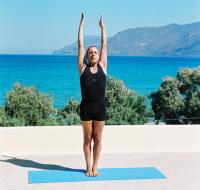
Tadasana-Mountain-Pose

‘Tada’ means palm tree in sanskrit language. Tadasana or Mountain Pose is very similar to palm tree, also known as Urdhva Hastasana. It is very popular and one of the most easy yoga poses, which can be practiced by anyone without any problem. Tadasana is helpful for body stretching, making spine flexible and helps to increase height.

Tadasan has few variations which make it more popular.

Tadasana or Mountain Pose

Stand up straight keeping both feet join. Now, while inhaling, lift the heels up and raise both the hands straight up over the head, stretch the body upward as much as possible, palms should be facing each other. This is the final pose of normal Tadasana or Mountain Pose.
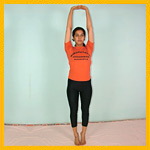
Urdhva-Tadasana
Urdhva-Tadasana Hastasana

Urdhva Tadasana or Extended Mountain Pose

This posture is like normal tadasana except hands position. Hands are joined together with interlocked fingers, then raise hands over the head, palms should be facing upward. Now, keeping all the body weight on toes, strech the body and hands upward as much as possible.

Tiryaka Tadasana

It is an extension of Urdhva Tadasana. While hands are stretched, the body is bend to left side from the waist as much as possible and then to the right side one by one.
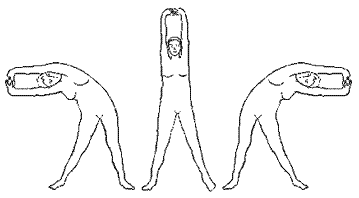
Tiryaka-Tadasana

Benefits

  • Tiryaka Tadasana  cures the stiffness of spine and increases it’s flexibility.
  • Tadasana is helpful for increasing height and cures waist problems.
  • This is good for the all abdominal organs.
  • Tiryaka Tadasana is very helpful for reducing side abdominal fat.

Similar Posts

  • Shavasana | Corpse Pose

    Shavasana or ‘Corpse Pose’ is normally practiced at the beginning and at the end of yoga session, because the purpose is to relax of the body completely including mind and spirit. This is excellent asana for reducing tiredness, stress and tension. Procedure 1. Lie down comfortably on the back, keep legs apart from each other….

  • Padmasana | Lotus Pose

    Lotus Pose or Padmasana is widely practiced asana for meditation and kundalini awakening. In India all the yogies sit most of the time in Padmasana. In this pose the devine energy flows upwards from Muladhar to Sahasrara Chakra. Procedure 1. Sit on the floor with your legs stretched straight in front. 2. Bend the right…

  • Shalabhasana | Locust Pose

    Shalabhasana in Sanskrit means ‘locust’. This posture resembles a locust. Process-1 1. Keeping face downwards lie flat on abdomen and chest. 2. Place hands under each thigh 3. Now breathing in lift the right leg up, do not bend the knee. 4. Repeat this from other leg. 5. Repeat it two to four times. Process-2…

  • Agnisar Kriya

    Agni means fire and “sara” means ‘essence’, kriya means ‘action’. It is a cleansing practice in which internal fire is stoked. It helps to heat up the body from within in order to stimulate digestion and detoxify the bodily systems. Process of Agnisara Kriya by Swami Ramdev ji 1. Sit in a comfortable pose of…