Utthanpadasana | Raised Legs Pose

Uttan means raised and pada means feet in Sanskrit. It is also known as raised legs pose.
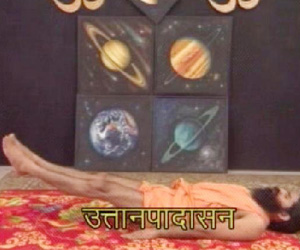
Procedure

1. Lie down with legs together, keep hands by the side of body and palms facing floor.
2. Now raise both legs to 30 degrees, while breathing in, do not jerk while lifting legs.
3. Hold your breath if not patient of high blood pressure as long as convenient.
4. Bring legs down while exhaling without bending knees.
5. Relax and do it three to six times.

Ardha-uttanpad asana means lifting one leg only and putting other on the floor. It’s procedure is same as above.

Duration

Raise the legs for ten to fifteen second. Do not practices for more than five times at a stretch. Do it in the morning and in the evening as well

Benefits

  • Gives strength to all abdominal muscles.
  • Strengthen thighs, waist, hips, back, spinal cord.
  • Reduce stomach.
  • Useful in constipation , wind trouble,  and in indigestion.

Precautions

  • Practice calmly because high pressure and stretching is felt on lower abdomen.
  • Patient of spondylitis and muscle pull should avoid this asana.
  • Patient of spinal injury must do it with one leg and don’t put undue strain on spine.
  • Raise the legs slowly without putting extra pressure on mind or body.

Similar Posts

  • Bakasana | Crane Pose

    Baka in Sanskrit language means crane which is a bird. This is a compact arm balance posture which gives a lot of patience to the tense person. It tones up, strengthen the abdominal organs and arms. Arm balances require patience, concentration, cheerful behavior and not huge strength. Process 1. Place the palms of both hands…

  • Mayurasana | Peacock Pose

    Mayur in Sanskrit language means ‘peacock’, in this posture, the body takes the shape of peacock. In this asana, one has to hold the whole body like a stick on the both elbows. Process 1. Start with sitting on knees and place the palms on ground while finger pointing towards stomach. 2. Take a deep…

  • Padmasana | Lotus Pose

    Lotus Pose or Padmasana is widely practiced asana for meditation and kundalini awakening. In India all the yogies sit most of the time in Padmasana. In this pose the devine energy flows upwards from Muladhar to Sahasrara Chakra. Procedure 1. Sit on the floor with your legs stretched straight in front. 2. Bend the right…

  • Shavasana | Corpse Pose

    Shavasana or ‘Corpse Pose’ is normally practiced at the beginning and at the end of yoga session, because the purpose is to relax of the body completely including mind and spirit. This is excellent asana for reducing tiredness, stress and tension. Procedure 1. Lie down comfortably on the back, keep legs apart from each other….