Mayurasana | Peacock Pose

Mayur in Sanskrit language means ‘peacock’, in this posture, the body takes the shape of peacock. In this asana, one has to hold the whole body like a stick on the both elbows.
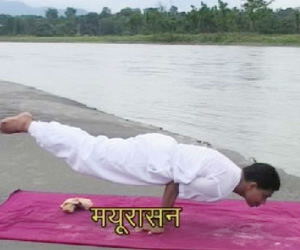
Process

1. Start with sitting on knees and place the palms on ground while finger pointing towards stomach.
2. Take a deep breath and place both elbows on both sides of navel now raise the thighs, buttock.  Head and knees will be parallel to each other.
3. Keep the knees one feet from each other.
4. Keep the wrists and palms towards the knees
5. Place the entire weight on the palms, hands, and elbows and maintained the balance.
6. Exhale  to return to original state and relax.

Duration

Hold the breath for two to four seconds and repeat it from two to three times, extended up to one minute later on.

Benefits

  • Improves digestive system.
  • Cleans bowels.
  • It increases gastric juices and can whet the appetite.
  • Helps to cure diseases of intestines and stomach.
  • Cures diabetes.
  • Strengthens the wrists,arms,lungs,ribs.
  • Tones up liver.
  • Improves pancreas.

Precaution

  • Person with the problem of cervical spondylitis should avoid this asana to avoid any problem later on.
  • Patient of high blood pressure should avoid this posture.
  • Avoid this asana in case you have abdominal surgery done.
  • Don’t jerk while doing this asana at any stage.
  • Stop doing this posture if you feel imbalance while performing.
  • Patient of hernia or ulcer should avoid it.

Similar Posts

  • Agnisar Kriya

    Agni means fire and “sara” means ‘essence’, kriya means ‘action’. It is a cleansing practice in which internal fire is stoked. It helps to heat up the body from within in order to stimulate digestion and detoxify the bodily systems. Process of Agnisara Kriya by Swami Ramdev ji 1. Sit in a comfortable pose of…

  • Vrikshasana | Tree pose

    Vriksh means a tree and this pose resembles a tree and is known as the tree pose. It helps to strengthen the back, calves, thighs and ankles. Flexibility of groin and hips area get increased. Balance and concentration is improved. Process 1. Begin with Tadasana. 2. Place the both hand on ground while standing up,…

  • Vrschikasana | Scorpion Pose

    Vrschik in Sanskrit means scorpion and this asana resembles a scorpion ready to strike its victim by arching its tail above its back. The person should make an attempt to feel comfortable in holding headstand posture and handstand pose before doing the scorpion pose. Process 1. While sitting on ground  place both hands on ground…

  • Bakasana | Crane Pose

    Baka in Sanskrit language means crane which is a bird. This is a compact arm balance posture which gives a lot of patience to the tense person. It tones up, strengthen the abdominal organs and arms. Arm balances require patience, concentration, cheerful behavior and not huge strength. Process 1. Place the palms of both hands…

  • Halasana | Plow Pose

    Hala is a sanskrit word, which means ‘plow’. Body looks like a plow while practicing Hala Asana. This posture is like an extension to Sarvangasana. Benefits of Halasana pose are numerous like sarnangasana. Procedure 1. Lie down on the back comfortably inhale through nostrils, joint both legs together and raise upwards slowly, till legs make…