Bakasana | Crane Pose

Baka in Sanskrit language means crane which is a bird. This is a compact arm balance posture which gives a lot of patience to the tense person. It tones up, strengthen the abdominal organs and arms. Arm balances require patience, concentration, cheerful behavior and not huge strength.
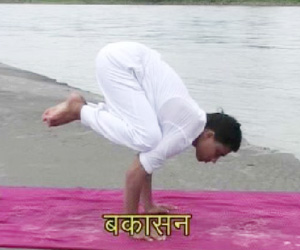
Process

1. Place the palms of both hands on ground and then place the knees above the elbow on the arms.
2. While taking deep breath place the body weight on palms and then try to lift the legs from ground to upside as possible.
3. Now stay in this posture from few seconds to one minute.
4. Exhale to lower the feet slowly to the ground and squat.

Benefits

  • Strengthens arms and wrists.
  • Strengthens upper back.
  • Strengthens abdominal muscles.
  • Abdominal organs get toned up.

Precautions

  • Avoid it in carpal tunnel syndrome.
  • Don’t do it in pregnancy
  • Keep the eye in front of  you and not looking down.
  • Extend the arms as much as possible once the balance is achieved in this posture.
  • Keep on breathing and don’t hold it.
  • Stop this asana in case the pain is felt.
  • Do it under the supervision of experienced yogi.
  • Heart and high Blood pressure patient, don’t try it even.
  • Old aged person should be cautious while doing it.
  • Children  from the age of ten years onward can do it under the supervision of experienced person.
Strengthens upper back

Similar Posts

  • Vrschikasana | Scorpion Pose

    Vrschik in Sanskrit means scorpion and this asana resembles a scorpion ready to strike its victim by arching its tail above its back. The person should make an attempt to feel comfortable in holding headstand posture and handstand pose before doing the scorpion pose. Process 1. While sitting on ground  place both hands on ground…

  • Shavasana | Corpse Pose

    Shavasana or ‘Corpse Pose’ is normally practiced at the beginning and at the end of yoga session, because the purpose is to relax of the body completely including mind and spirit. This is excellent asana for reducing tiredness, stress and tension. Procedure 1. Lie down comfortably on the back, keep legs apart from each other….

  • Konasana | Angle Pose

    Konasana or Angle Pose is also known as open angle or seated wide leg forward bends.  Kona means angle and asana means posture. Procedure 1. Stand up straight with keeping the distance of legs around two feet. 2. Inhale slowly to and turn body to the left bending at the waist to bring left hand…

  • Vrikshasana | Tree pose

    Vriksh means a tree and this pose resembles a tree and is known as the tree pose. It helps to strengthen the back, calves, thighs and ankles. Flexibility of groin and hips area get increased. Balance and concentration is improved. Process 1. Begin with Tadasana. 2. Place the both hand on ground while standing up,…

  • Vajrasana | Diamond Pose

    Vajrasana is a sanskrit word which has two parts, ‘vajra’ and ‘asana’. Vajra means ‘Thunderbolt’ or ‘Diamond’, therefore it is also called ‘Diamond Pose’. Procedure Vajrasana is an easy sitting posture. 1. Fold both the knees, keep them joint with each other and sit on the pit formed   by  the heels. 2. Keep the spine,…

  • Halasana | Plow Pose

    Hala is a sanskrit word, which means ‘plow’. Body looks like a plow while practicing Hala Asana. This posture is like an extension to Sarvangasana. Benefits of Halasana pose are numerous like sarnangasana. Procedure 1. Lie down on the back comfortably inhale through nostrils, joint both legs together and raise upwards slowly, till legs make…