Utthanpadasana | Raised Legs Pose

Uttan means raised and pada means feet in Sanskrit. It is also known as raised legs pose.
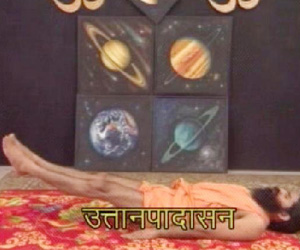
Procedure

1. Lie down with legs together, keep hands by the side of body and palms facing floor.
2. Now raise both legs to 30 degrees, while breathing in, do not jerk while lifting legs.
3. Hold your breath if not patient of high blood pressure as long as convenient.
4. Bring legs down while exhaling without bending knees.
5. Relax and do it three to six times.

Ardha-uttanpad asana means lifting one leg only and putting other on the floor. It’s procedure is same as above.

Duration

Raise the legs for ten to fifteen second. Do not practices for more than five times at a stretch. Do it in the morning and in the evening as well

Benefits

  • Gives strength to all abdominal muscles.
  • Strengthen thighs, waist, hips, back, spinal cord.
  • Reduce stomach.
  • Useful in constipation , wind trouble,  and in indigestion.

Precautions

  • Practice calmly because high pressure and stretching is felt on lower abdomen.
  • Patient of spondylitis and muscle pull should avoid this asana.
  • Patient of spinal injury must do it with one leg and don’t put undue strain on spine.
  • Raise the legs slowly without putting extra pressure on mind or body.

Similar Posts

  • Vajrasana | Diamond Pose

    Vajrasana is a sanskrit word which has two parts, ‘vajra’ and ‘asana’. Vajra means ‘Thunderbolt’ or ‘Diamond’, therefore it is also called ‘Diamond Pose’. Procedure Vajrasana is an easy sitting posture. 1. Fold both the knees, keep them joint with each other and sit on the pit formed   by  the heels. 2. Keep the spine,…

  • Halasana | Plow Pose

    Hala is a sanskrit word, which means ‘plow’. Body looks like a plow while practicing Hala Asana. This posture is like an extension to Sarvangasana. Benefits of Halasana pose are numerous like sarnangasana. Procedure 1. Lie down on the back comfortably inhale through nostrils, joint both legs together and raise upwards slowly, till legs make…

  • Mayurasana | Peacock Pose

    Mayur in Sanskrit language means ‘peacock’, in this posture, the body takes the shape of peacock. In this asana, one has to hold the whole body like a stick on the both elbows. Process 1. Start with sitting on knees and place the palms on ground while finger pointing towards stomach. 2. Take a deep…

  • Tadasana | Mountain Pose

    ‘Tada’ means palm tree in sanskrit language. Tadasana or Mountain Pose is very similar to palm tree, also known as Urdhva Hastasana. It is very popular and one of the most easy yoga poses, which can be practiced by anyone without any problem. Tadasana is helpful for body stretching, making spine flexible and helps to…