Pranayama is a Sanskrit compound word, which consists of two parts, ‘Prana’ and ‘Ayam’. Prana is life force or vital energy (breath) and Ayam is extension or expansion. Pranayama stands for ‘control of the life force’. In yoga it is more specifically mean as “breath control”.
Pranayama is a part of Yoga, which specifically consists of different breathing exercises. To control the breath and turn it to evolve the life energy is the main purpose. In modern age it is also known as ‘Yogic Breathing’.
The basic theory of Pranayama Yoga can be described in one sentence, “The life starts and ends with the breath”. What What is Pranayama Yoga is described very well in the following article:
Patanjali Yoga Sutras
Following are the eight “limbs” or steps prescribed in the second pada of the Yoga Sutras:
Yama – Code of conduct – self-restraint
Niyama – religious observances – commitments to practice, such as study and devotion
Asana – integration of mind and body through physical activity
Pranayama – regulation of breath leading to integration of mind and body
Pratyahara – abstraction of the senses, withdrawal of the senses of perception from their objects
Dharana – concentration, one-pointedness of mind
Dhyana – meditation (quiet activity that leads to samadhi)
Samadhi – the quiet state of blissful awareness, superconscious state
Pranayama is the fourth ‘limb’ of the eight limbs of Raja Yoga according to‘Yoga Sutras of Patanjali’. Patanjali describes pranayama as the control of life force that comes as a result of practicing the various breathing techniques.
Swami Ramdev ji Maharaj
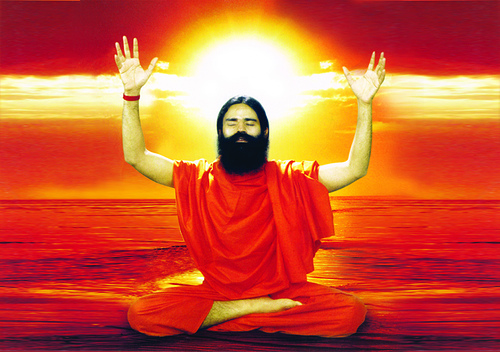 Pranayama has been limited to yogis and unknown to general people for a long time. The credit of making it extremely popular to common people goes to Swami Ramdev ji Maharaj. He not only brought pranayama to masses but proved it’s miracles by applying on millions of patients suffering from non-curable diseases. His ashram is situated in India while persons who got benefited by his easy pranayama sequence and techniques are spread all over the world. A good number among those are of patients who returned just from the ‘door of death’. He takes ‘Pranayama Classes’ in his ashram, in different cities in India and abroad, which is attended by thousands of people at a time.
Types Of Pranayama
Pranayama means breathing techniques in various methods. In ancient Indian yoga books, lots of pranayamas are described to various benefits. These are Bhastrika, Kapalbhati, Bahya, Anuloma Viloma, Bhramari, Udgeeth, Ujjayi, Sheetali, Deergha, Nadi Shodhana, etc.
Swami Ramdev ji selected most effective and easy to practice pranayamas from ‘Yoga sutras of Patanjali’ for common people.
Seven step Pranayama by Swami Ramdev ji
Ramdev ji created a seven step specific pranayama package to maximize benefits for common people and patients, which is proved now as most successful and miraculous packages so far. The seven-step pranayam package is sufficient along with daily routine. The whole process takes around 45 minutes and the duration can be increased up to two hours also.
How to do Pranayama Yoga ?
Types and sequences of pranayama yoga with ‘Mudra Bandha’ by Swami Ramdev ji are as followes :
Bhastrika Pranayama
Kapalbhati Pranayama
Bahya Pranayama
Anulom Vilom Pranayama
Bhramari Pranayama
Udgeeth Pranayama
Ujjayi Pranayama
Benefits
Pranayama Yoga have numerous benefits including physical and mental both. Spiritual heights can be achieved with pranayama very easily. The first step for Kundalini awakening is started by meditation and pranayama yoga.